Mateusz Dworczyk
Gaisbergstraße 26
AT – 5020 Salzburg
01
Body Rorschach
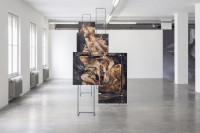
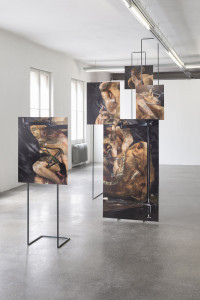

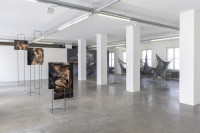
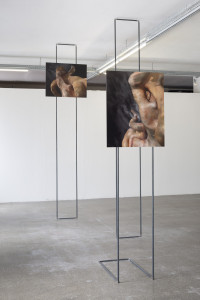
2026. 5-part series, 80 x 65 cm / 150 x 85 cm, (pigment print, Hahnemühle Photo Rag Baryta, unframed on aluminum composite panel).
»[...] These works aim to redirect, reframe, and challenge our perspective. For recognizing the forms of violence that have become invisible—those embedded in our very flesh and bones as well as in forests and meadows—and exposing them as constructed realities is an emancipatory muscle that can never be exercised enough.« Excerpt from »Muskelübungen gegen die Gewalt« (Muscle Exercises Against Violence) by Simon Nagy, published published in the exhibition catalogue.
02
Procedural Incarnation II


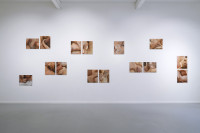
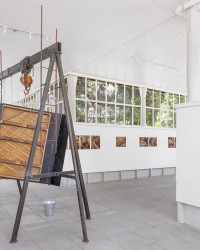
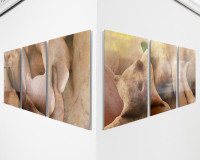
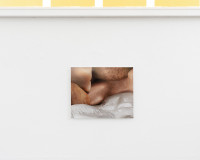
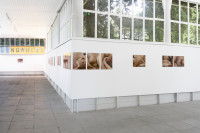
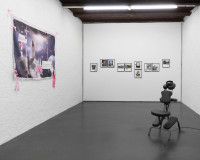
2023. Installation Fotogalerie Wien: Series of 4 images (97 x 78 cm, unframed, mounted on aluminum composite panel). Pigment prints on Hahnemühle Fine Art Baryta, wall text.
Installation Stadtgalerie Kiel: Series of 20 images (40 x 50, unframed, unframed, mounted on aluminum composite pane). Pigment prints on Epson Traditional, 5 digital graphics (40 x 50, black and white UV print on acrylic glass), wall text.
My approach is rooted in a postmodern understanding of the body, viewing it as a malleable entity and challenging its conventional status as a natural object. »Procedural Incarnation« utilizes advanced image production techniques, exploring the intersection of technology, the human body, and body image. Using digital body photographs as a starting point, I utilize machine learning to produce new body images. The imperfect image, which reflects a distorted perception of the world by a transclassical machine, serves as the basis for creating three-dimensional body models. This creates a tense relationship between different imaging processes, but also an interplay between the template and the artistic interpretation of it.
03
Procedural Incarnation I
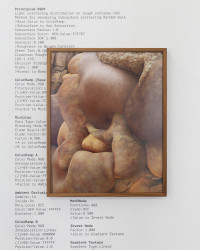
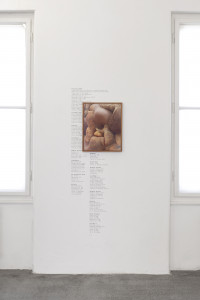


2023. Two-channel video, full HD, 08:40 min / 12:00 min. Pigment print (50 x 40 cm), vinyl wallpaper (60 x 90 cm).
In the postmodern, the body and its image become malleable. Its position as a natural object is rightly examined and questioned in relation to cultural, scientific, political or economic factors. Therefore, contemporary body images must accordingly be understood as sociotechnically constructed images. New tools, such as artificial intelligence and three-dimensional simulations, are an addition to the media landscape and at the same time a challenge for the medium of photography. Real-time game applications such as "metahuman" already show simple ways to create human bodies and identities. These approaches are mostly based on statistical variations to describe and give meaning to the appearance of the human body. However, artificially created bodies are not a unique feature of today's computer games. They can be found in socio-technical networks, films, music videos or magazines. In the process, they are highlighted as bodies of art or are completely integrated into other conventional forms of representation. Precisely these phenomena and the new imaging techniques are taken up in the work. At the same time, these circumstances and developments are subverted by dispensing with normative-organic organisation and common representation of the human body.
04
Inter_Places
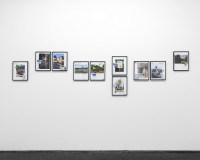
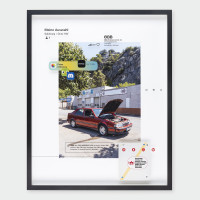
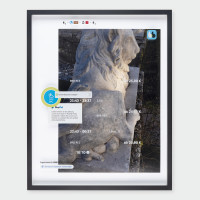
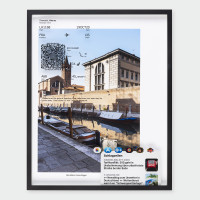
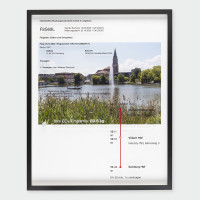
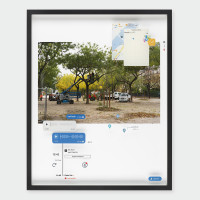
2024. 10-part series (35 x 28 cm), pigment print on fine art photo paper, UV-printed acrylic glass.
Significant parts of our society are almost permanently exposed to the omnipresence of digital devices. As a result, travelling is now also accompanied by various apps: Push notifications, traffic information, emails, boarding passes, news widgets, reception status or battery status. These app interfaces are inscribed into the memory of smartphones as screenshots. They are a snapshot of our navigation, a trace of our mobility and a fragment of our perception of the world. Too unimportant to be deleted, screenshots are archived in the camera roll on an equal footing with photographs. Passively inscribed and yet part of our memory.
Over the course of two years, the material for the ten-part picture series was collected during various business and leisure trips. On display are classic photographs: unagitated descriptions of places as a traveller's personal commentary. Places that are sometimes intertwined, but do not depict a linear sequence. In the foreground there are digital collages from private screenshot collections. An interface taken ad absurdum, overlaying the common representation of the image. Or is it the anticipated future perception of the world, as large technology companies are already trying to foresee with mixed reality products like Apple Vision Pro glasses?
05
Body Options II
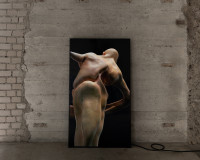


2022. Video (48:00 min, 4K, no sound), Image series (40 x 30 cm), 3D print bust (PLA, 35 x 30 x 20 cm).
»Body Options II« (2022) is the latest installation by Mateusz Dworczyk, which was on display at Kiel's art association »Kunstraum B«. In his transmedial practice, the media artist explores the interplay between technology, the human body, and its pictorial representation. The focus lies particularly on photo-based digital imaging techniques such as machine learning and 3D technology. The work is built on the subset of results of an artificial neural network (trained on a self-created data set of ballet dancers) which contains outcomes that are usually defined as errors in the image-generating process. Those »errors« are then translated into three-dimensional space by using 3D-Software.
The images of these sculpted bodies appear in competition with normative body representations and the subjective body images of the visitors themselves. They infest the exhibition space, materialise, and affect the viewer. They show the power and impact of immaterial transclassical machines like artificial neural networks and remind us that technical instruments, apparatuses, and systems have always had anthropological relevance and a considerable influence on the idea of the human body, its function, form, and image.
»Body Options II« opens up a space of imagination that oscillates between present possibilities and future scenarios. However, neither angstlust-rhetoric (the pleasure of fright) nor fear of technology is the subject of the work. But rather the question of the omnipresent relationship between technology, the human body, and the ever-changing image of the body. Dworczyk aims to question the functional logic of technology which is transferred to the body. His work tries to visually oppose the inherent tendencies of standardisation, optimisation, and utilitarianism, as well as the organisation of the body into an organism through the artistic examination of a body without organs.
06
Body Options I


2021. Single-channel video projection (2 x 1,5 m, 05:35 min), dancers: SueKi Yee, Christopher Carduck, sound assistance: Christian Werner Sierra.
07
Room for two


2019. A series of screenshot-compositions.
Focusing on phenomena of the presentation of self in everyday life and the question what part the real-time frame-medium »Internet« plays in this context, this work is dedicated to a special form of digital staging. This includes live webcams and especially sex webcams. The Focus lies on the arising elusive situation. The viewer is confronted with an overwhelming array of stagings and windows from all over the world. They allow a glance into supposedly private housing-situation. The screen recording has been used to capture a brief moment in which no person was in the picture. The fluid real-time image has become a photographic snapshot. The Internet has become a place of self- and external representation with elusive, ambiguous boundaries between private and public spaces.
08
Memeclassworldwide
MCW


Collaborative project.
Visit our website.
Detailed information on projects:
mcww.toxic (2026),
mcww.voyage (2024),
mcww.service (2022),
mcww.memes (2018 – 2022)
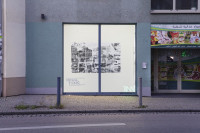
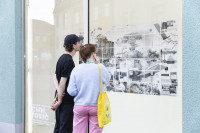
memeclassworldwide (mcww) is a series of collaborative projects by Ramona Kortyka, Jennifer Merlyn Scherler, Mateusz Dworczyk and Juan Blanco that took its initial form as an institution-critical meme account in 2018 and transformed into an autonomous class at a German art academy in 2019. Based on the internet as a reference space, the group investigates post-digital phenomena, considering the range of their aesthetic, social and political dimensions. The gathered insights are integrated into practices of teaching and exhibiting. To this date, the artist group has held numerous lectures and organised different seminars, workshops, and research residencies in the D-A-CH-region. Since 2022 the collective defines itself as a roaming working group that approaches institutions from outside.
09
Witness to the (digital) world
F/D


2020. A series of screenshot-compositions (digital print on PVC banner 1,7 x 6,4 m and 1,7 x 3,2 m folded as objects).
Fleckstein/Dworczyk contrasts anonymity with prominence and self-presentation in social networks. By including one's own self-image (selfie), as well as using the aesthetics of social software interfaces, the romanticised image of the uniformed individual is to be negated.
10
Room on display
F/D


2020. Installation NAK: two-channel video/sound loops (03:40, 04:14 min) on two screens (55"), mattresses innerspring, mirrored revolving stage, Pfizer pills, glass and mirror smartphones (5.8") and various personal objects. Installation Futur3: two-channel video/sound loops (03:40, 03:00 min) on two screens (55"), white carpet (140 x 140cm), glass and mirror smartphones (5,8"), MA1 jacket, cable drum as well as various personal objects.
»Fake people with fake cookies and fake social-media accounts, fake-moving their fake cursors, fake-clicking on fake websites.« (Read; 2018) — Through a dialogic approaches, our related subjects are united in this two channel video installation. The idiosyncratic narrative tries to describe everyday turnarounds that usually go unnoticed. The interplay with these boundaries (and their reversal) is adopted in the spatial arrangement. In addition to commonalities in content, formal aspects of digital cultural techniques are addressed through the manipulation of digital surfaces.
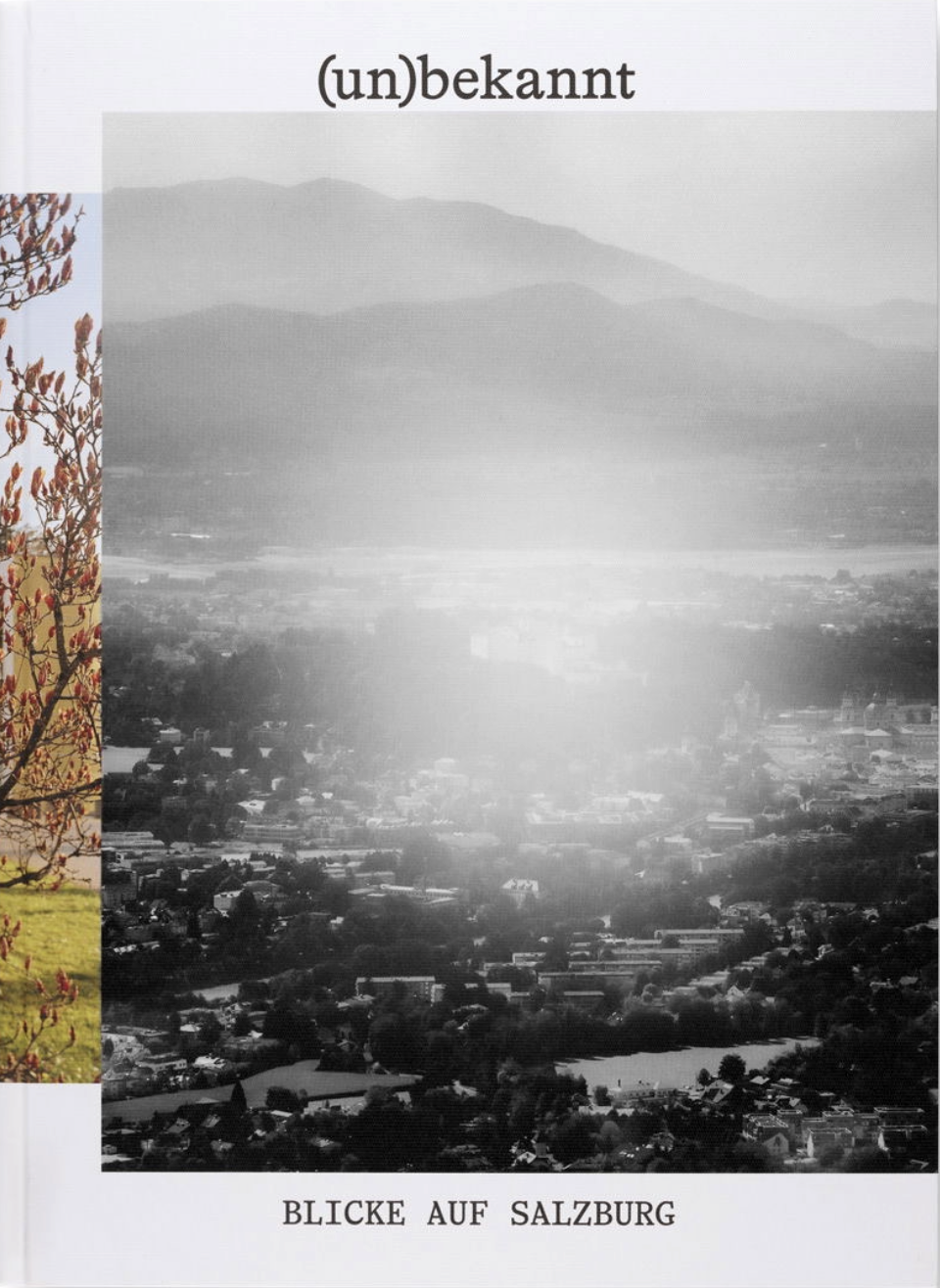
(un)bekannt: Blicke aus Salzburg
Eds.: Martin Hochleitner, Rainer Iglar, Michael Mauracher
Text: Various authors (German)
Design & typesetting: Studio Fjeld
Edition: 700
2025, Semi-rigid cover, 33 × 24 cm
192 pages, ∞ sw- and colour plates
ISBN: 978-3-903334-92-2 / 25€
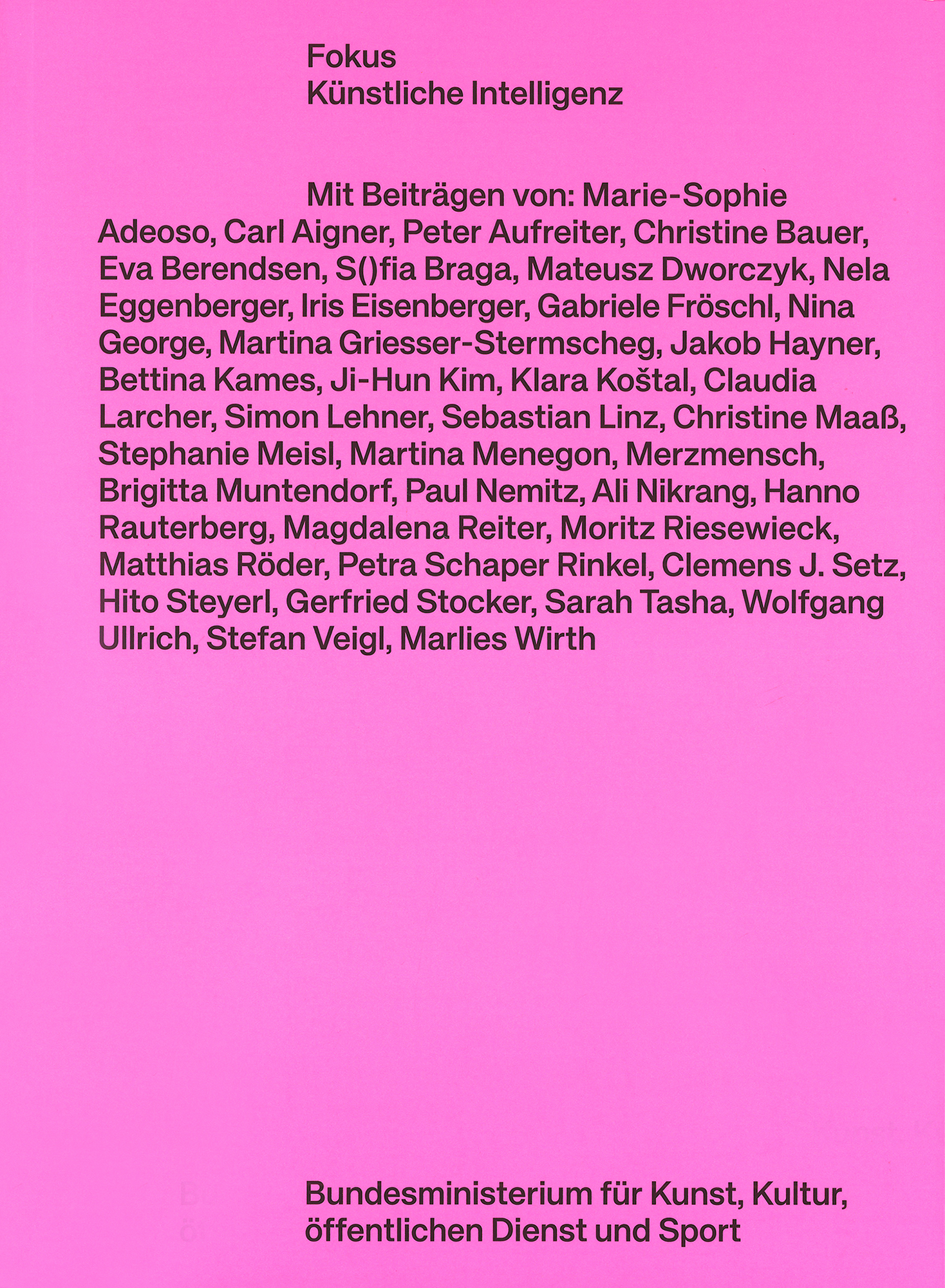
Fokus: Künstliche Intelligenz
Eds.: Austrian Federal Ministry for Arts, Culture, the Civil Service, and Sport
Text: Various authors (German, English)
Design & typesetting: 101 Coding und Design
2024, Softcover, 26 × 19 cm
227 pages, ∞ colour plates
ISBN: 978-3-200-09977-7 / Purchase on request

FLECKSTEIN / DWORCZYK: Witness to the (digital) world.
Eds.: NAK Neuer Aachener Kunstverein, Hannes Fleckstein, Mateusz Dworczyk
Text: Peggy Schoenegge (English).
Design & typesetting: Káschem Büro, Insa Kühlcke-Schmoldt & Nina Massow
Edition: 100
2022, Softcover, thread binding, 29 × 21 cm
86 pages, ∞ color plates
ISBN: 978-3-929261-99-8 / Purchase on request / 28€

MEMECLASSWORLDWIDE: Research, Documentation, Index
Eds.: Ramona Kortyka, Mateusz Dworczyk, Juan Blanco, Bernhard Garnicnig
Text: Bernhard Garnicnig (English)
Design & typesetting: No Talent Studio
Edition: 80
2021, Softcover, perfect binding, 24 × 16 cm
224 pages, ∞ color plates
Purchase on request / 35€
In my artistic practice, the focus lies on the influence of digital technologies on the construction of our world. In particular, it addresses the malleability of the human body in visual media, as well as the question of how cultural, scientific, political, or economic conditions shape bodies and representations of the body. My current focus lies on cultural-historical contexts and media-theoretical concepts, such as the body as a divisible material and a measurable entity, or the skin as a surface for communication and projection. My multimedia works reference, among other things, visual worlds that emerge within socio-technical networks. These include user-generated content such as posts, memes, or comments, as well as the visual interfaces of various platforms. Through my choice of artistic strategies and visual tools, I negotiate the malleability of the body across different media dimensions: from photography to 3D simulation to machine learning.
–
The collaborative work with Hannes Fleckstein (Fleckstein/Dworczyk, 2018 – 2024), has been an ongoing dialogue where our individual perspectives intersect. This website showcases both my individual positions and the joint projects. This collaboration responds to how individuals and society handle image data on the World Wide Web. We were particularly interested in the affective power of these images and their ability to shape public discourse, political contexts, and everyday life. Through continual interaction with various social software, digital surfaces, and algorithms, we create new visual worlds. These worlds, presented through images and videos, explore digital phenomena and cultural techniques, seeking to reveal what often goes unnoticed. The resulting works are presented as spatial installations that address the blurring line between the physical world and digital applications.
–
memeclassworldwide (mcww) is a collaborative project by Ramona Kortyka, Jennifer Merlyn Scherler, Mateusz Dworczyk, and Juan Blanco that took its initial form as an institution-critical meme account in 2018 and transformed into an autonomous class at a German art academy in 2019. Based on our internet as a reference space, we investigate post-digital phenomena, considering the range of their aesthetic, social, and political dimensions. The gathered insights are integrated into practices of teaching and exhibiting. To this date, we have held numerous lectures and organized different seminars, workshops, and research residencies in the D-A-CH region. Since 2022, we define ourselves as a roaming working group.
Mateusz Dworczyk
- May 1994
Zabrze, Poland
2019 — 2022
Master of Arts (Photography) under Prof. Peter Hendricks and Prof. Dr. phil. habil. Petra Maria Meyer at Muthesius University of Fine Arts and Design
2015 — 2019
Bachelor of Arts (Photography) under Prof. Peter Hendricks and Prof. Dr. phil. habil. Petra Maria Meyer at Muthesius University of Fine Arts and Design
–
2024
Gottfried Brockmann Preis der Landeshauptstadt Kiel
2019 — 2022
Scholarship at the Hans Böckler Foundation
2020
Work and study visit at Escola Maumaus, Lisbon
2026
»_scapes and _bodies«, Galerie Fünfzigzwanzig, Salzburg [d];
2025
»Unsere Kunst. Eure Kunst«, Stadtgalerie Kiel [g];
2025
»This world is but a ghost«, Frappant Galerie, Hamburg [g];
2024
»Weder Blume, noch Fleisch«, Galerie Bunker-D, Kiel [d];
2024
»Feels like Venice«, Stadtgalerie Salzburg, Zwergelgartenpavillon [g]
2023
»Digital III – Generativ«, Fotogalerie Wien, Wien [g]
2023
»Gottfried-Brockmann-Preis«, Stadtgalerie Kiel, Kiel [g]
2023
»an/ab/wesend« with Keita Morita, Gallery Cubeplus, Kiel [d]
2022
»Mache mir einen Menschen!«, Kunstraum B, Kiel [s]
2021
»Gottfried-Brockmann-Preis«, Stadtgalerie Kiel, Kiel [g]
2020
»Contact« group billboard exhibition in the city area of Kiel [g]
2018
»first revolution would be to change the way we look at things« Group performance with Yvon Chabrowski at Stadtgalerie, Kiel
Fleckstein/Dworczyk
2021
»witness to the (digital) world«, NAK Neuer Aachener Kunstverein, Aachen
2021
»abgefuckt liebt dich«, Atelier Umraum, Alte Mu, Kiel (organizer and exhibiting artists)
2020
»Turn of the tide« group exhibition, Futur 3 Festival, Kiel
2019
»66. Landesschau BBK SH«, Schloss Gottorf, Schleswig
2019
»1949.1985.1994«, Flämische Straße, Kiel (organizer and exhibiting artists)
2018
»Von hier sieht alles ganz anders aus« during »Museumsnacht«, Alte Mu, Kiel
memeclassworldwide
2025
»Pollution of the Internet«, Projektraum 11m3, Weimar [s]
2024
»Are you happy to be in Paris?«, Künstlerhaus Palais Thurn und Taxis, Bregenz [g]
2022
»What Can Artists Do Now?«, Galerie Elisabeth and Klaus Thoman, Wien [g]
2021
»Einhundert Geburtstagskerzen auf einer Buttercremetorte«, Oberbilker Allee 57, Düsseldorf [s]
2020
»Escaleras futuras«, Galeria Santa Fe, Bogotá [g]
2020
»Collection« group poster exhibition, Kunsthalle zu Kiel [g]
2019
»I didn‘t know it was that easy«, Prima Kunst Container, Stadtgalerie Kiel [s]
Special thanks to the team from kirby-cms.
Copyright — The content and works published on this website are governed by the copyright laws of Germany. Any duplication, processing, distribution or any form of utilisation beyond the scope of copyright law shall require the prior written consent of the author or authors in question. In particular, third-party content is identified as such. Should you nevertheless become aware of a copyright infringement, please inform us accordingly. If we become aware of any infringements, we will remove such contents immediately.
External Links — Our website contains links to the websites of third parties. As the content of these websites is not under our control, we cannot assume any liability for such external content. In all cases, the provider of information of the linked websites is liable for the content and accuracy of the information provided. At the point in time when the links were placed, no infringements of the law were recognisable to us. As soon as an infringement of the law becomes known to us, we will immediately remove the link in question.
Data Protection — A visit to our website can result in the storage on our server of information about the access (date, time,page accessed). This does not represent any analysis of personal data (e.g., name, address or e-mail address). If personal data are collected, this only occurs – to the extent possible – with the prior consent of the user of the website. Any forwarding of the data to third parties without the express consent of the user shall not take place.We would like to expressly point out that the transmission of data via the Internet (e.g., by e-mail) can offer security vulnerabilities. It is therefore impossible to safeguard the data completely against access by third parties. We cannot assume any liability for damages arising as a result of such security vulnerabilities.The use by third parties of all published contact details for the purpose of advertising is expressly excluded. We reserve the right to take legal steps in the case of the unsolicited sending of advertising information; e.g., by means of spam mail.